
Generative Engine optimisation (GEO) for cybersecurity vendors.
Table of Contents
- 1. Make Sure Your Cybersecurity Content Is Indexed On Both Bing and Google
- 2. Write Content That Matches AI Search Engine Intent
- 3. Create Rich Content for humans and AI
- 4. Build Links from Authoritative Sources to Specific Content Assets
- Generative Engine Optimization (GEO) FAQ for Cybersecurity Companies
- 1. What is Generative Engine Optimization (GEO)?
- 2. Why does AI search matter for cybersecurity companies?
- 3. Create Rich Content for humans and AI
- 4. Does ranking high on Google or Bing guarantee my content will appear in AI searches?
- 5. How do AI searches differ from traditional searches?
- 6. What is rich content, and why does it matter?
- 7. How can backlinks improve my Cybersecurity GEO strategy?
- 8. Can you provide an example of a successful Cybersecurity GEO strategy?
- 9. How can I start optimizing my content for AI search?
How do you make your cybersecurity company's name or content appear In ChatGPT Search, Claude, Perplexity and AI overview (Gemini) results in 2026 and beyond?
Since ChatGPT Search launched and Perplexity and Claude began to gain notable search engine market share, we’ve been working to make sure our cybersecurity marketing agency’s clients’ content (and our own) appears in AI-powered search engine results.
Content Visit is a cybersecurity GEO agency (we won cybersecurity marketing agency of the year in 2026 for this service). We are experts at helping you show up in (AI) and LLM search results on Google, Chat GPT, Claude, Perplexity and more.
Contact us for a free GEO consultation.
By “appear,” we mean show up as either a direct recommendation in ai conversations or as a referenced link at the end of a result or within the result i.e a "citation".
While it's still relatively early days in AI-powered search (and these search engines represent a very small percentage of overall search traffic), we can stand over these four pieces of AI-SEO advice for any B2B brand that wants to rank well in AI-powered search, using our agency as an example.
Here's what we recommend
1. Make Sure Your Cybersecurity Content Is Indexed On Both Bing and Google
ChatGPT Search and Perplexity both say that they use a combination of search engines.
Our experience is that if you are not indexed on Bing, you will not show up on either.
Check if your brands content is indexed by checking Bing Webmaster.Generally speaking, the higher you rank on these search engines' traditional results pages, the more likely you are to feature in AI-powered search engine results.ChatGPT Search and Perplexity draw results from a mixture of Bing and Google.
Of course, this is not always the case, and we have seen examples where low-ranking content will appear in AI-powered search results when the user intent is very specific.
If your website is not indexed on Bing Search, you are unlikely to rank in AI-powered search engines.However, it’s worth noting that ranking no.1 on Bing (or any other search engine) does not ensure you will be at the top of ChatGPT Search or Perplexity.
2. Write Content That Matches AI Search Intent and Fan-Out
Answer the problem the reader is trying to solve early in your content and be conversational.
Use “I”, “we,” and “you” as much as possible. This demonstrates first-hand experience.Taking a (relatively) conversational approach is a good idea for any content you hope people will find through a search algorithm. Put concrete claims and statistics in the first 100 ish words.
Don't just say "we are the most efficient or have the best detections etc", explain exactly why. Better yet quote concrete examples or case studies.
What might be different with AI search is how someone frames their problem statement. That’s why intent, i.e., why someone is searching, matters as much as what they are searching.
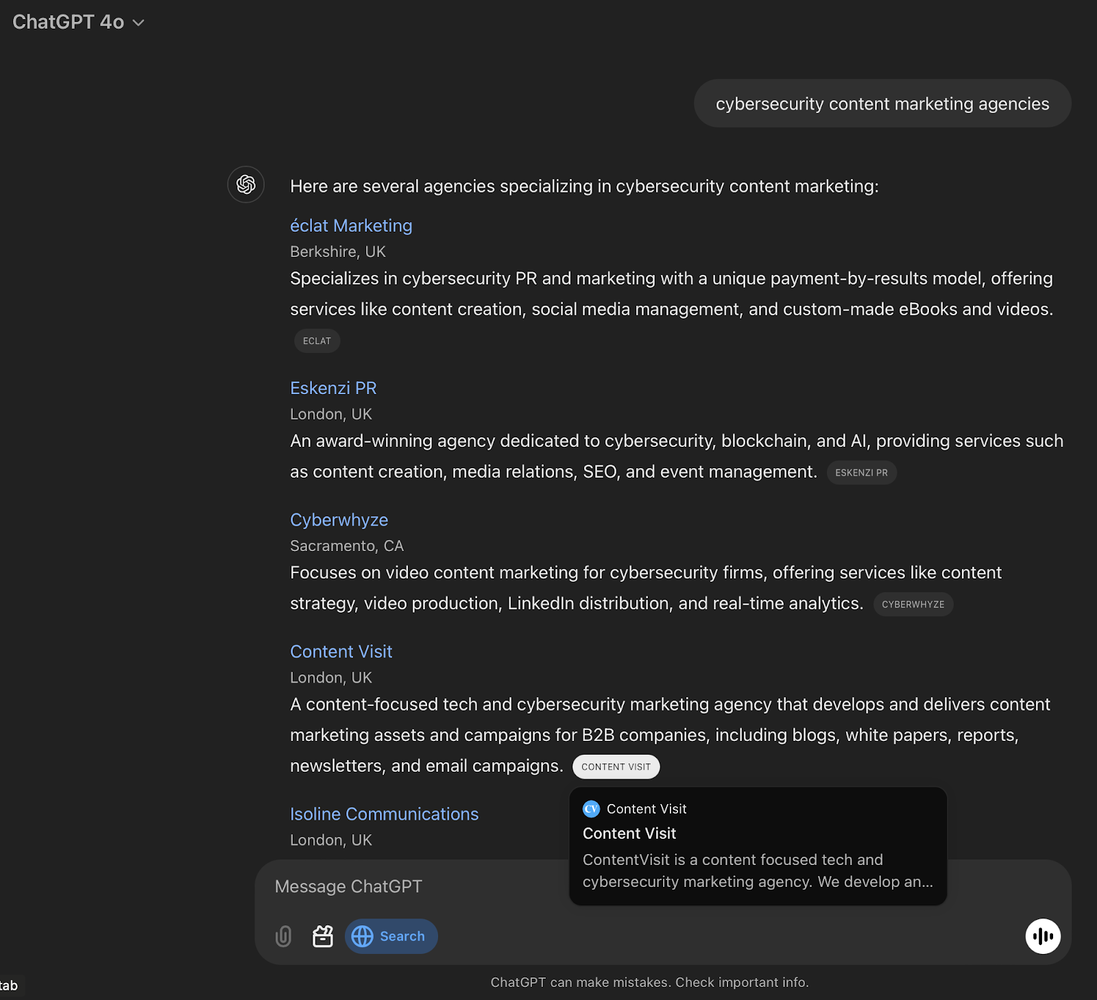
Traditional search engines tend to encourage short tail searches, e.g., “cloud security AWS.”
AI search can be more specific, e.g., “how can I make my AWS assets safer from hacks?”
AI encourages users to ask more specific "natural" questions rather than searching with single keywords.Then, with AI search, the user might ask continuous, detailed questions, possibly resulting in something like “How can I automate this.”
However...
All AI search engines then turn those really long tail queries back in to shorter search queries which are then sent to search engine API's. For example Claude uses brave search.
Often a single query into an LLM is turned into multiple search queries sent to APIs. These are so called "fan out queries".
One search in "Endpoint protection for law firms" can because several searches (in the case of Claude) in Brave.
If you want to learn more about how this works please contact us and I will happily give you a ten minute explanation for free.
3. Create Rich Content for humans and AI
Rich content is content that is more than blocks of text. It’s content that is filled with useful comparison tables, call-outs, bulleted lists, graphics, and even videos.
Make sure to include a description in images that includes the keyword you are targeting.Content that gives the reader multiple ways to understand the topic at hand is rich content.
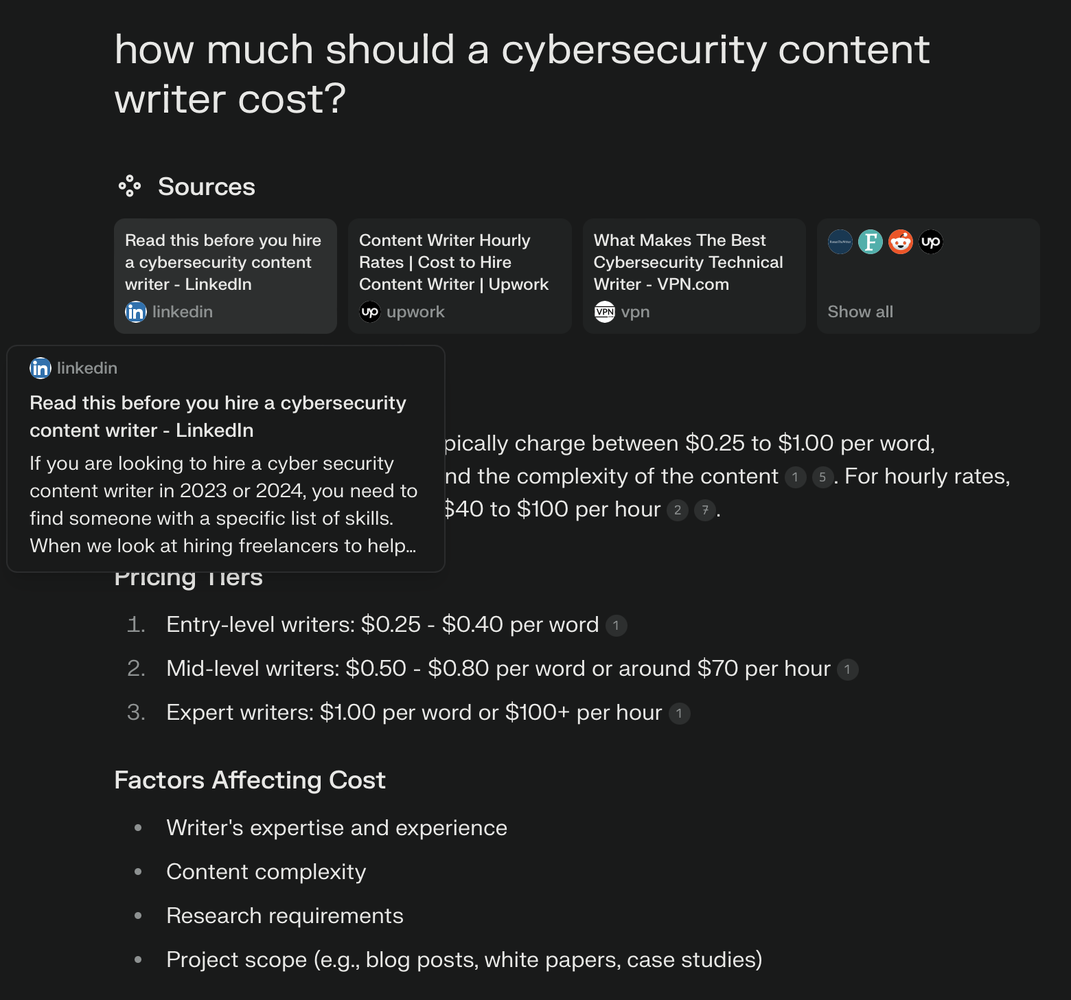
We have plenty of examples where rich content we’ve created for clients, like a comparison table between two niche solutions, has been presented directly back during ChatGPT Search queries.
Relevant locational data can also be useful, i.e., where your service is located on a map. We’ve seen this kind of result pop up a lot too.
4. Build Links from Authoritative Sources to Specific Content Assets
Just like in traditional SEO, topical backlinks that directly refer to your content in relation to the query are the best way to demonstrate authority.Having your brand featured as a reference in third-party articles, e.g., guest posts, round-up lists, or reviews, is a great way to do this.
We are not able to give specific examples of how domain authority relates to AI-powered search engine results, but we’ve noticed that in more competitive searches, having over three topically relevant links helps a lot.The same way you see links in Google summarized Search results.
Generative Engine Optimization (GEO) FAQ for Cybersecurity Companies
Here's a few of the questions we hear cybersecurity marketing and product teams asking about GEO strategy .
1. What is Generative Engine Optimization (GEO)?
GEO is the process of optimizing your cybersecurity company's content to appear in AI-powered search engines like ChatGPT Search and Perplexity. It involves indexing on Bing and Google, aligning content with AI search intent, optimising for fan-out queries, using rich media, and building authoritative backlinks.
2. Why does AI search (GEO) matter for cybersecurity companies?
AI-driven search is growing rapidly, and many security buying teams now turn to ChatGPT Search and Perplexity for solution insights. If your brand isn’t optimized for these platforms, you could miss valuable visibility.
3. How can I ensure my brand's content appears in AI search results?
Index on Bing and Google
: If your content isn’t indexed on Bing, it’s unlikely to appear in AI search results. Use Bing Webmaster Tools to check.
Match AI search intent
: AI searches tend to be more natural and question-based. Structure content around specific cybersecurity problems and solutions.
Create rich content
: Use comparison tables, bullet points, graphics, and videos to make your content more engaging.
Build authoritative links
: Secure backlinks from reputable sources that directly reference your cybersecurity insights.
4. Does ranking high on Google or Bing guarantee my content will appear in AI searches?
Not necessarily. AI search engines use different ranking factors. While strong SEO helps, AI models prioritize relevance to the query’s intent, conversational tone, and direct problem-solving.
5. How do AI searches differ from traditional searches?
Traditional searches often use short-tail keywords (e.g., “cloud security AWS”), whereas AI search queries are more natural and detailed (e.g., “How do I secure AWS assets from attacks?”). AI searches also encourage follow-up questions, making in-depth, structured content more effective.
6. What is rich content, and why does it matter?
Rich content goes beyond text—it includes images, tables, lists, videos, and interactive elements. AI search engines prefer rich content because it improves user experience and provides multiple ways to engage with information.
7. How can backlinks improve my Cybersecurity GEO strategy?
Links from authoritative cybersecurity sources help validate your content’s credibility. AI search engines recognize these backlinks, increasing your chances of being referenced in search results.
8. Can you provide an example of a successful Cybersecurity GEO strategy?
Yes! We’ve helped cybersecurity vendors secure visibility in AI search results through targeted content strategies. Contact us to see a case study of how one vendor achieved prominent placement in AI-generated responses.
9. How can I start optimizing my content for AI search?
Reach out to our team, and we’ll guide you through the process of Generative Engine Optimization (GEO) to ensure your cybersecurity brand is discoverable in AI-driven search results.
Contact us if you want more information about creating content that features in AI search. We can send you a case study of how we got one vendor featured prominently in AI search queries.
Written by Robert Galvin