
Should Cybersecurity Startups Invest in SEO, Content Marketing or AI Visibility in 2026?
The short answer is yes.
A recently funded or growth orientated cybersecurity vendor or service provider must invest in SEO, Generative Engine Optimization (GEO) and Content Marketing in order to capture or grow market share in 2026.
Of course, we are very biased on this topic. Content Visit is a top cybersecurity marketing agency that specializes in AI search visibility for cybersecurity companies alongside traditional SEO (i.e., "Google").
But regardless of who you ask (startup founders, scale-up product managers, enterprise CMOs), the answer to the question in the title will still be yes.
According to StartUs Insights' 2025 Cybersecurity Report, there are over 9,900 cybersecurity startups on the market today.
Meanwhile, research from Gartner and others shows that B2B buyers are 70% through their buying journey before they even contact a vendor. The reality is that there is no alternative to being present on AI search or SERPs.
Capture a Powerful Lead Generation Engine for Early Stage Cybersecurity Companies
In the tests we've run, visitors to a cybersecurity company’s website that come from organic sources (i.e., not from a paid ad) are significantly more likely to engage with your sales team than traffic driven through paid placement. This aligns with industry research from Adcore showing that organic search converts at 14.6% compared to 10% for PPC.
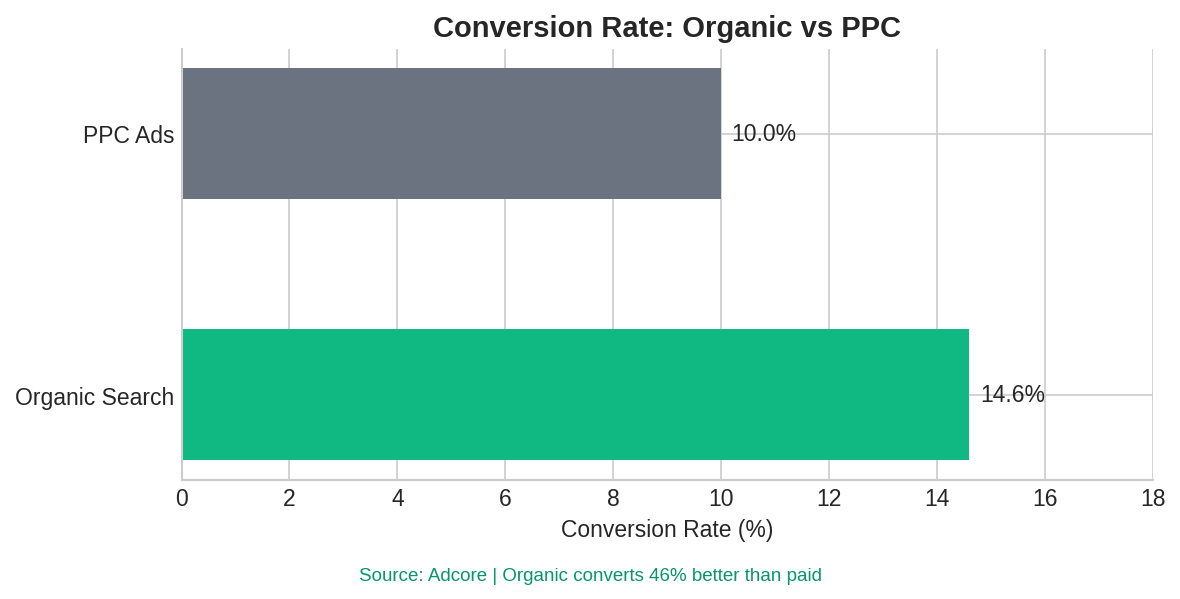
Paid growth channels still have a very important role in cybersecurity marketing campaigns, but it's also worth noting that the cost of paid growth has increased significantly.
WordStream's 2024 Google Ads Benchmarks found that 86% of industries saw CPC increases, with an average rise of 10% year-over-year. Some sectors like real estate experienced increases of over 35%.
No cybersecurity company can rely on paid advertising for inbound lead generation alone. However, there is a catch with organic traffic too.
Organic visibility takes a relatively long time to compound. According to First Page Sage's SEO ROI research, it typically takes 6 to 12 months to see positive ROI from SEO work, with peak performance in years two and three. That's why we usually recommend combining SEO and paid growth.
The ROI on SEO can be substantial.
Research from SingleGrain reports an average SEO ROI of 748%, while Digital World Institute finds B2B SEO campaigns can deliver between 500% and 1,200% ROI.
This high return comes about because SEO is a relatively small investment that compounds over time. It might cost you $1,000 to write a quality blog post, build some backlinks to it and strategically interlink with your site, but if that post ranks for a year or more it can easily generate traffic worth several times that amount.
In fact, we work with cybersecurity companies that are able to replace significant paid ad spend with organic content.
In one B2B cybersecurity SEO case study, we helped a client grow from 77 ranking keywords to over 800 in just one year, with individual pillar pages ranking for nearly 150 search terms each.
Don't Let Organic Be a Missed Opportunity For Your Solution
As outlined above, there is a major opportunity for cybersecurity companies that invest in organic visibility and SEO/AI-SEO.
For example, if your cybersecurity company's name or content does not show up in AI search tools like CHAT GPT, Claude, Perpleixty or Google when buyers ask questions about their problems or your solution type, you will not get RFQs or demos from in-market B2B software buyers.
Failing to rank organically also leaves the door open for your competitors.
If you don't invest in SEO, you can be sure that your competitors will spot and take that advantage and even dominate the narrative around your brand on search engines.
How to Use SEO, Content Marketing and AI Visibility to Grow Your Cybersecurity Startup in 2026
Our advice to any cybersecurity company that wants to be present in search engines in 2026: create useful content + build your site's authority + repurpose and distribute.
Cybersecurity marketing content
Content is information about the problems your solution solves, how you solve them, and why it makes financial or operational sense to solve those problems with your solution vs others. It can be anything from a landing page on your site to an ROI calculator to a solution brief you hand somebody at a conference.
It must be useful and informative (but entertaining is nice too). A skilled cybersecurity content writer can help you create everything from blog posts to whitepapers to case studies.
Link building to grow your cybersecurity brand's online authority
Authority is the credibility and trust signals that search engines use to rank your content. One effective way to build authority is through guest posting on cybersecurity publications like Dark Reading, Security Boulevard, and Security Magazine.
Cybersecurity content distribution
Distribution is the process of getting that content in front of people interested in solving the same problems you solve. It can be digital or word of mouth/in person (i.e., you hand someone a flyer at an expo). For a comprehensive overview, see our guide to 8 B2B content distribution channels for cybersecurity companies.
We recommend that content be created with distribution in mind. It should work if boosted with a paid post, repurposed into a LinkedIn article, turned into an email nurture stream, or even made into a YouTube video.
Paid
Paid traffic capture like Google PPC ads, LinkedIn ads, and increasingly Reddit ads have a major role in the lead generation mix.
Our approach is that these efforts should support the content marketing and SEO work you do on your site. For example, we typically start by creating high-quality blog content for clients that is designed to rank in the long term, then drive traffic to it immediately with paid ads to see what works and what doesn't.
This speeds up the testing and discovery processes and also helps get short-term proof of concept.
What's Different About AI Visibility vs "Traditional SEO"? in the Cybersecurity Market
Not much.
Honestly, getting visibility on traditional search engines and AI-powered search engines or AI overviews is a broadly similar approach.
The key difference between SEO and AI is that you are also optimizing your content and your site (and your backlinks) for contextual relevance and fan-out queries. If you would like to know more about this topic, please contact us.
How do we know this? We ranked our agency in various AI search engines during 2025 and 2026 and got inbound leads as a result.
We did this by means of a series of on-page and off-page actions including creating bespoke websites, mapping fan-out queries from AI search engines (and optimizing for them), building content depth and interlinking, and placing guest posts on third-party sites.
Get AI to recommend your Cybersecurity Startup in 2026
Content Visit is an organic and AI visibility specialist.
We help cybersecurity companies show up as recommendations on Google, ChatGPT, Claude, Perplexity, and other search engines with conversion-focused content marketing. You can see examples of our work in our case studies, including our partnerships with IBM/Randori, Morphisec, and DeleteMe.
Get in touch with us to learn more.
Written by Robert Galvin